

Seven-partner CIRCUIT project will use a molten-salt process to recover tantalum and rare earths that conventional smelting loses, while reusing components and feeding end-of-life realities back into board design.
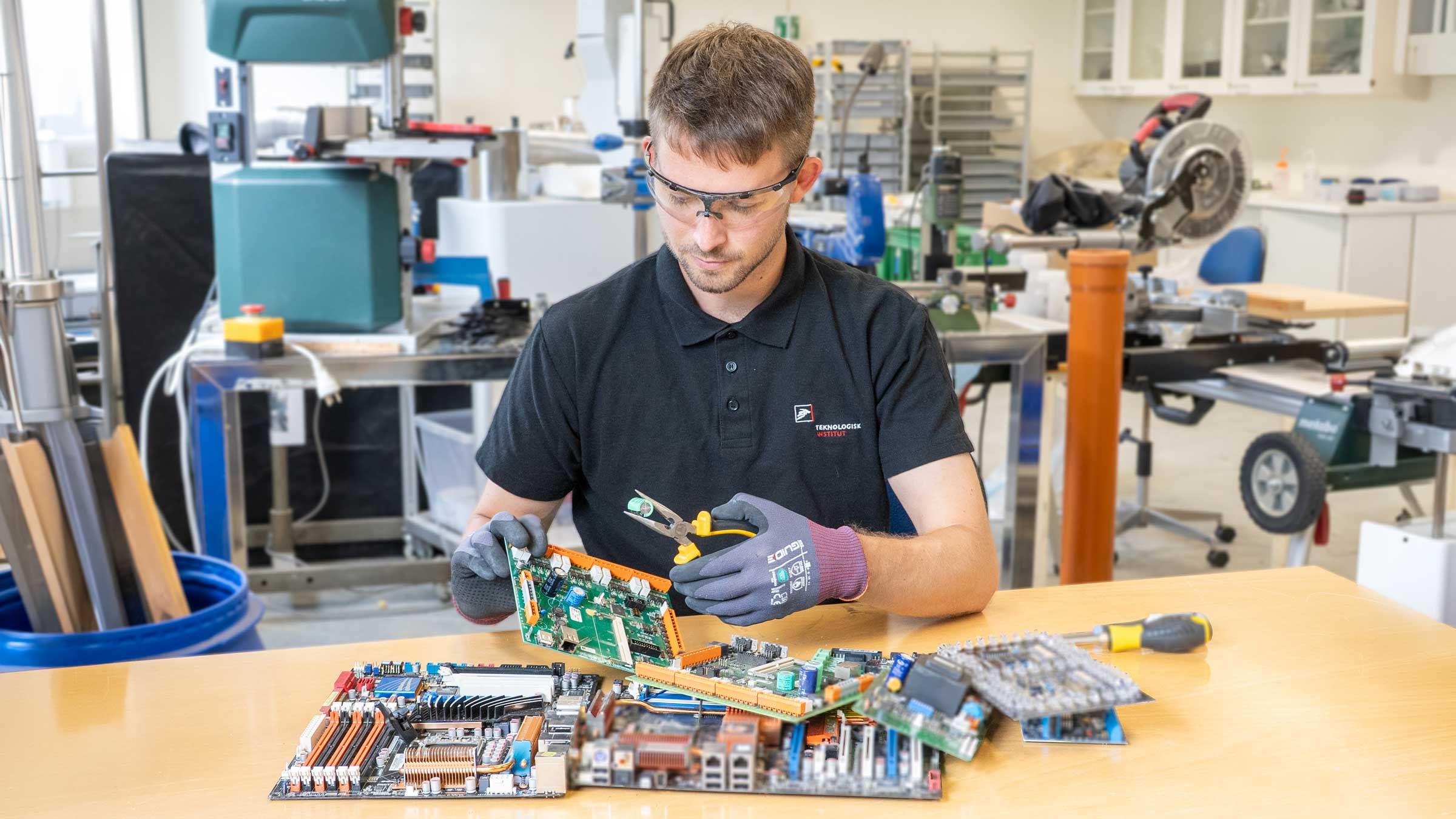
A consortium of seven Danish companies has begun a three-year, DKK 9.2 million (around £1.1 million) project to recover tantalum, rare earth elements and reusable components from scrapped circuit boards, targeting the critical materials that conventional high-temperature recycling destroys.
Most printed circuit board recycling shreds and smelts the boards to recover bulk metals such as gold and copper. Tantalum and rare earth elements, which Europe relies heavily on imports for, are largely lost in that process, ending up in the slag rather than the recovered metal. Going after those materials is where the project, named CIRCUIT, departs from current practice.
The wider problem is growing. Electronic waste is among the fastest-growing waste streams worldwide, with volumes up 82 per cent between 2010 and 2022, even as Europe remains dependent on imported critical raw materials and electronic components. Apple has estimated that the gold and copper in one tonne of used phones is equivalent to 2,000 tonnes of ore extracted from a mine.
CIRCUIT is led by El Recycling, a Danish electronics recycler, with the Danish Technological Institute as project manager, and runs to 2028 with support from the Danish Environmental Protection Agency's environmental technology programme, MUDP, under the Ministry of the Environment. The boards hold materials that "Europe desperately needs", according to project manager Aisha Rafique, who noted that printed circuit boards and components also account for most of the carbon footprint of electronic products.
Molten-salt recovery process
The recovery work falls to Nordic Salt Cycle, a Copenhagen start-up founded in 2024, which has developed a molten-salt process that extracts tantalum and rare earth elements at lower temperatures than conventional smelting. The approach is designed to reach the materials that high-temperature processing cannot recover economically.
"Europe is almost entirely dependent on imported critical minerals, but much of that value is already in our waste," said James Amphlett, chief technology officer at Nordic Salt Cycle. "We unlock that potential by providing the low-cost refining technology that Europe currently lacks."
A second track in the project targets reuse. Many boards are coated with epoxy-based materials that make them hard to take apart without destroying the parts worth saving, so the project will develop methods for gentler disassembly and quality assurance that allow working components to be removed intact and resold.
"If we can remove the components in a gentle and efficient way, it opens up new business opportunities for reused and quality-assured electronic components," said Casper Roensbech of El Recycling, the project's lead applicant.
The third track brings the companies that design and make boards into the same project as those who dismantle them. Working with PCB supplier NCAB Group, actuator manufacturer LINAK and power systems firm DEIF, CIRCUIT will test design principles intended to lower the carbon footprint of future production and make boards easier to recover at end of life.
"CIRCUIT is particularly valuable because the project brings together the entire PCB value chain, from design and production to end-of-life management," said Gitte Jespersen, senior research and development manager at DEIF. "This enables us to explore solutions that can be integrated into our existing development and design processes."
The global market for critical minerals used in the energy transition has doubled in five years, according to the Draghi report on European competitiveness, with demand projected to rise four to six-fold by 2040. Export restrictions from major suppliers, including China, have also risen fivefold since 2009, and during the chip shortage of 2020 to 2023 hundreds of manufacturers halted production when component supply collapsed.
By recovering critical raw materials closer to home, the consortium aims to support the supply security set out in the EU's Critical Raw Materials Act. Alongside El Recycling, the Danish Technological Institute and Nordic Salt Cycle, it includes recycler HJHansen Recycling Group, NCAB Group, LINAK and DEIF.


Get our weekly digest
resource.co article ai

How will the government and DMOs address the challenges of including glass in DRS while ensuring a level playing field across the UK?
There's no easy solution to include glass in the DRS while maintaining a level playing field. Potential approaches include a phased introduction of glass, potentially with higher deposits to reflect its logistical challenges. The government and DMOs could incentivise innovation in glass packaging design and subsidise dedicated return points for glass-handling. Exemptions for smaller businesses unable to handle glass might also be necessary. Any successful solution will likely blend several approaches. It must address the differing priorities of devolved administrations, balance environmental benefits with logistical and cost implications, and be supported by robust consumer education campaigns emphasizing the importance of glass recycling.