

Policy agenda from the Ellen MacArthur Foundation argues cotton, timber, rubber and leather have been comparatively overlooked by circular economy strategies built around finite materials.
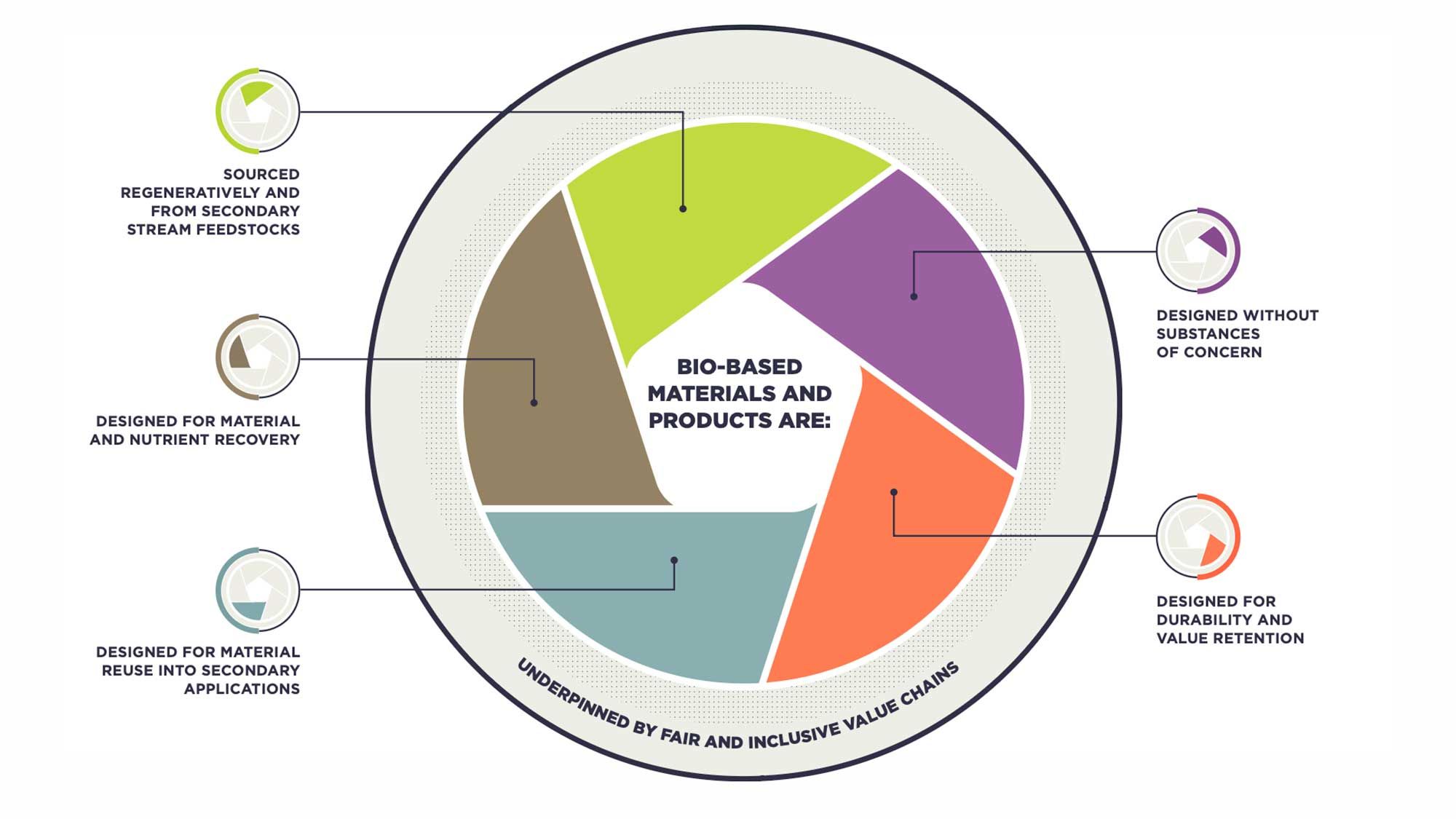
The Ellen MacArthur Foundation has published a policy agenda arguing that circular economy strategies worldwide have paid insufficient attention to bio-based materials - cotton, timber, natural fibres, rubber, leather and biochemicals - leaving substantial economic and environmental value on the table.
The report, Circular by Nature, analyses 13 national circular economy strategies and 18 bio-based materials policy frameworks from countries worldwide. It finds that these two policy agendas run in parallel but rarely intersect, each reinforcing its own logic at the expense of a coherent transition.
Most circular economy strategies treat bio-based materials as direct substitutes for non-renewable inputs, according to the foundation, rather than addressing how they are grown, circulated across successive applications and safely returned to biological systems. Bio-based material policies have the inverse problem: they frame these materials as renewable commodities to be extracted, converted into products and sent to energy recovery, without capturing the economic value from repair, refurbishment and recycling.
The foundation produced the report as an independent contribution to the discussions of the Circular Economy Coalition for Latin America and the Caribbean, but says the findings are applicable globally. It comes at a point when more than 100 countries have adopted national circular economy roadmaps or action plans - a 34 per cent increase since 2024 - yet policy frameworks for bio-based materials remain largely disconnected from that momentum.
A framework for alignment
Circular by Nature sets out five policy pillars it says are needed to bring the two agendas together: designing for circularity with regeneration as a core standard; enabling effective and safe material circulation by reviewing waste classifications that push bio-based materials prematurely into low-value treatment; redirecting financial incentives including agricultural subsidies towards regenerative practices and deploying eco-modulated EPR; investing in infrastructure from biorefineries to composting facilities; and cross-border collaboration on standards and trade.
At the centre of the framework is a distinction the foundation says current policies miss. Bio-based materials are renewable only insofar as the ecosystems producing them are given space and time to regenerate. Where extraction outpaces recovery - where soil health degrades, biodiversity declines and land conversion continues - renewable resources become effectively finite. Substituting non-renewable materials with bio-based alternatives can work, but must be evaluated against land use, ecological context and full life-cycle impacts.
The report draws on case studies, where companies have shown a willingness to innovate in this space. For example, Gucci has invested in regenerative production through a partnership with NATIVA, a natural fibre brand, covering 115,000 hectares of pastureland focused on soil health and carbon sequestration. Elsewhere, Brazilian pulp and paper company Klabin uses a “mosaic model” of forestry on degraded land, interspersing commercial forests of pine and eucalyptus with native species, and achieving 54 per cent higher annual productivity than the national average for pine.
Indian bio-based materials company MYNUSCo transforms agricultural waste into bio-composite pellets that replace plastics, paying farmers 15 rupees per kilo - two to three times the biofuel industry rate.
The report estimates that a nature-positive transition meeting the Kunming-Montreal Global Biodiversity Framework targets could be worth USD 10 trillion (around £7.9 trillion) a year globally by 2030. Bio-based products could eliminate up to 2.5 billion tonnes of CO2 equivalent annually in Europe alone, while a global shift towards a bioeconomy could deliver up to a third of the emissions reductions required to limit warming to 1.5 degrees Celsius.
For countries that produce bio-based materials, the foundation argues there is more to gain. Shifting from commodity export towards regenerative production, converting biomass into new materials and building local recirculation loops could reduce dependence on raw material exports and keep more value in the domestic economy. In the UK, the BBIA this week launched a BioRevolution Coalition campaign calling on the government to review tax and regulation that it says leaves domestic bio-based products more expensive than fossil-based alternatives - a policy gap the EMF report's framework would also address.
The report says waste regulations in many jurisdictions classify biomass and biogenic residues as waste rather than as secondary feedstocks. Reviewing these classifications to distinguish between materials that can be recovered, repurposed and transformed into new products - and contaminated residues that need controlled disposal - is, according to the foundation, a precondition for scaling bio-based circular systems.


Get our weekly digest
resource.co article ai

How will the government and DMOs address the challenges of including glass in DRS while ensuring a level playing field across the UK?
There's no easy solution to include glass in the DRS while maintaining a level playing field. Potential approaches include a phased introduction of glass, potentially with higher deposits to reflect its logistical challenges. The government and DMOs could incentivise innovation in glass packaging design and subsidise dedicated return points for glass-handling. Exemptions for smaller businesses unable to handle glass might also be necessary. Any successful solution will likely blend several approaches. It must address the differing priorities of devolved administrations, balance environmental benefits with logistical and cost implications, and be supported by robust consumer education campaigns emphasizing the importance of glass recycling.