

Funding will support scale-up of MykoSIP prefabricated wall panels, which grow from hemp shivs, hay and paper and brewing industry waste using engineered fungal strains.
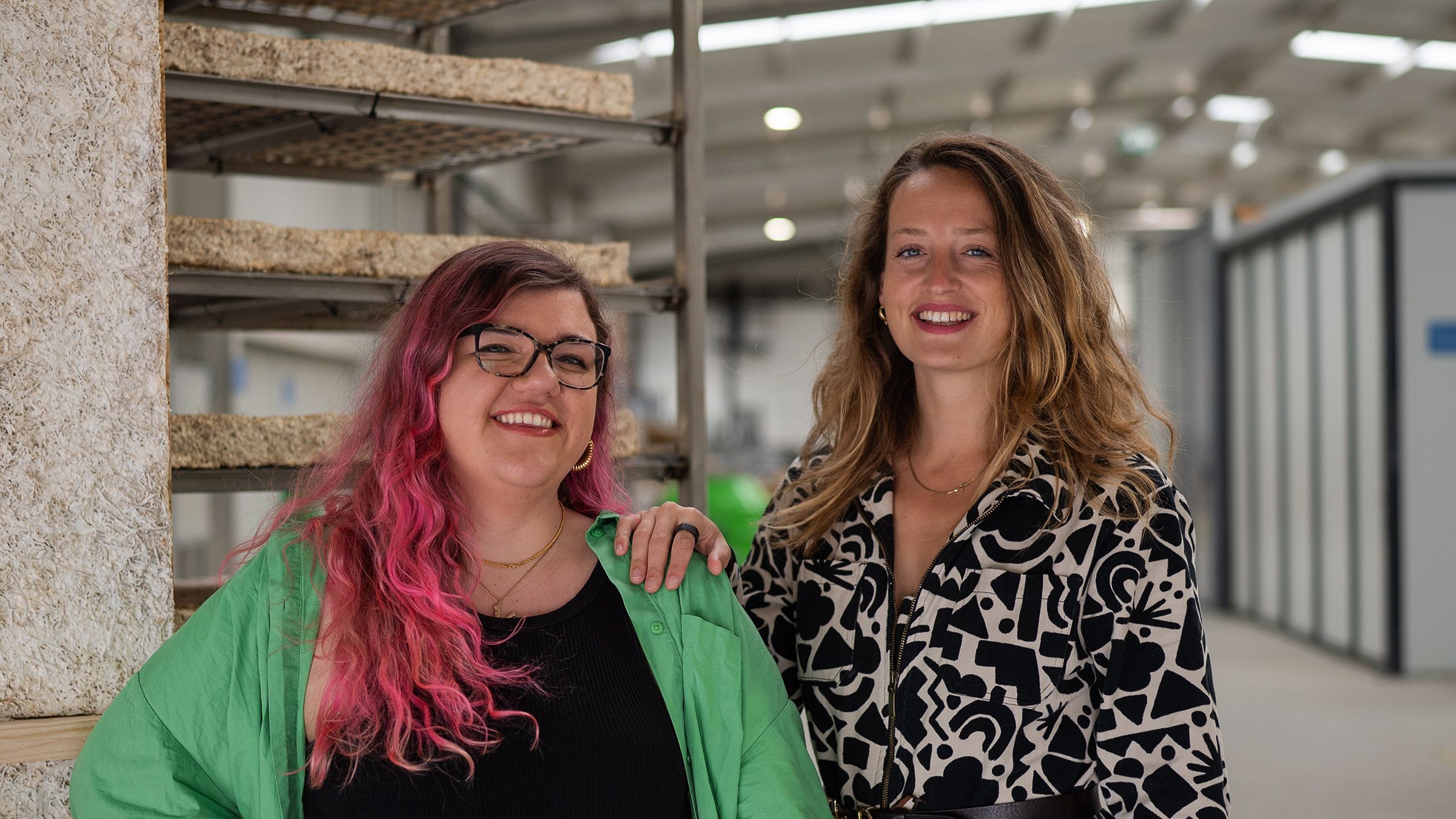
Bristol-based biotechnology company Mykor has raised £4 million to scale production of low-carbon construction panels grown from mycelium and agricultural waste. The round, led by climate tech venture capital fund Clean Growth Fund, brings the company's total funding to £7.5 million.
Mykor's first product, MykoSIP, is a prefabricated partition wall that uses engineered mycelium strains to bind a feedstock of hemp shivs, hay and waste from the paper and brewing industries. The mixture is formed into framed panels and the mycelium grows through the residues over a period of days. Panels are then treated with a bio-based coating for fire performance and mould resistance before drying and shipping to site.
The company, founded in 2021 by CEO Olivia Page and COO Valentina Dipietro, says MykoSIP achieves carbon savings of at least 50 per cent compared with conventional partition wall systems - an estimated 23kgCO2e per square metre - with higher savings when biogenic carbon storage is accounted for. The panels use 90 per cent less water and 40 per cent less electricity than polystyrene equivalents, and do not emit toxins as they degrade.
Mykor has secured £338 million in supply and offtake agreements with UK and European construction companies, and is already delivering live projects. Rather than manufacturing centrally, the company's model allows contractors and manufacturers to integrate the biomaterials into their own production lines - a structure the funding will now help replicate across markets.
The British Business Bank's South West Investment Fund, managed by The FSE Group, participated in the round alongside Green Angel Ventures and Innovate UK's investor partnership programme. Of the £7.5 million total, £5.5 million is equity investment and £2 million is grant funding.
Tightening building standards
Regulatory pressure on embodied and operational carbon in construction is increasing on both sides of the Channel. In England, the Future Homes Standard comes into force in March 2027, requiring all new homes to achieve a 75 per cent reduction in carbon emissions compared with 2013 standards. Across the EU, the revised Energy Performance of Buildings Directive, which member states must transpose by May 2026, mandates zero-emission new buildings from 2030 and requires renovation targets for the worst-performing existing stock.
Conventional insulation materials - predominantly polystyrene and mineral wool - are non-renewable and carbon-intensive to manufacture. As whole-life carbon assessments become standard practice, developers face pressure to reduce both embodied and operational emissions at once.
"We've built Mykor around the idea that decarbonising construction cannot come at the expense of cost, performance or practicality," said Page. "The challenge has never just been inventing a biomaterial - it's been manufacturing these systems at industrial scale and integrating them into real construction supply chains."
Susannah McClintock, investment partner at Clean Growth Fund, said the company's approach "integrates seamlessly into existing building practices and is cost-competitive with conventional materials - delivering meaningful carbon savings without adding cost."
Clean Growth Fund is a specialist climate tech venture capital platform established in 2020 to invest in UK innovations that reduce greenhouse gas emissions or improve resource efficiency. The Mykor investment is the fund's 22nd to date.


Get our weekly digest
resource.co article ai

How will the government and DMOs address the challenges of including glass in DRS while ensuring a level playing field across the UK?
There's no easy solution to include glass in the DRS while maintaining a level playing field. Potential approaches include a phased introduction of glass, potentially with higher deposits to reflect its logistical challenges. The government and DMOs could incentivise innovation in glass packaging design and subsidise dedicated return points for glass-handling. Exemptions for smaller businesses unable to handle glass might also be necessary. Any successful solution will likely blend several approaches. It must address the differing priorities of devolved administrations, balance environmental benefits with logistical and cost implications, and be supported by robust consumer education campaigns emphasizing the importance of glass recycling.